← The Framework03

Alignment

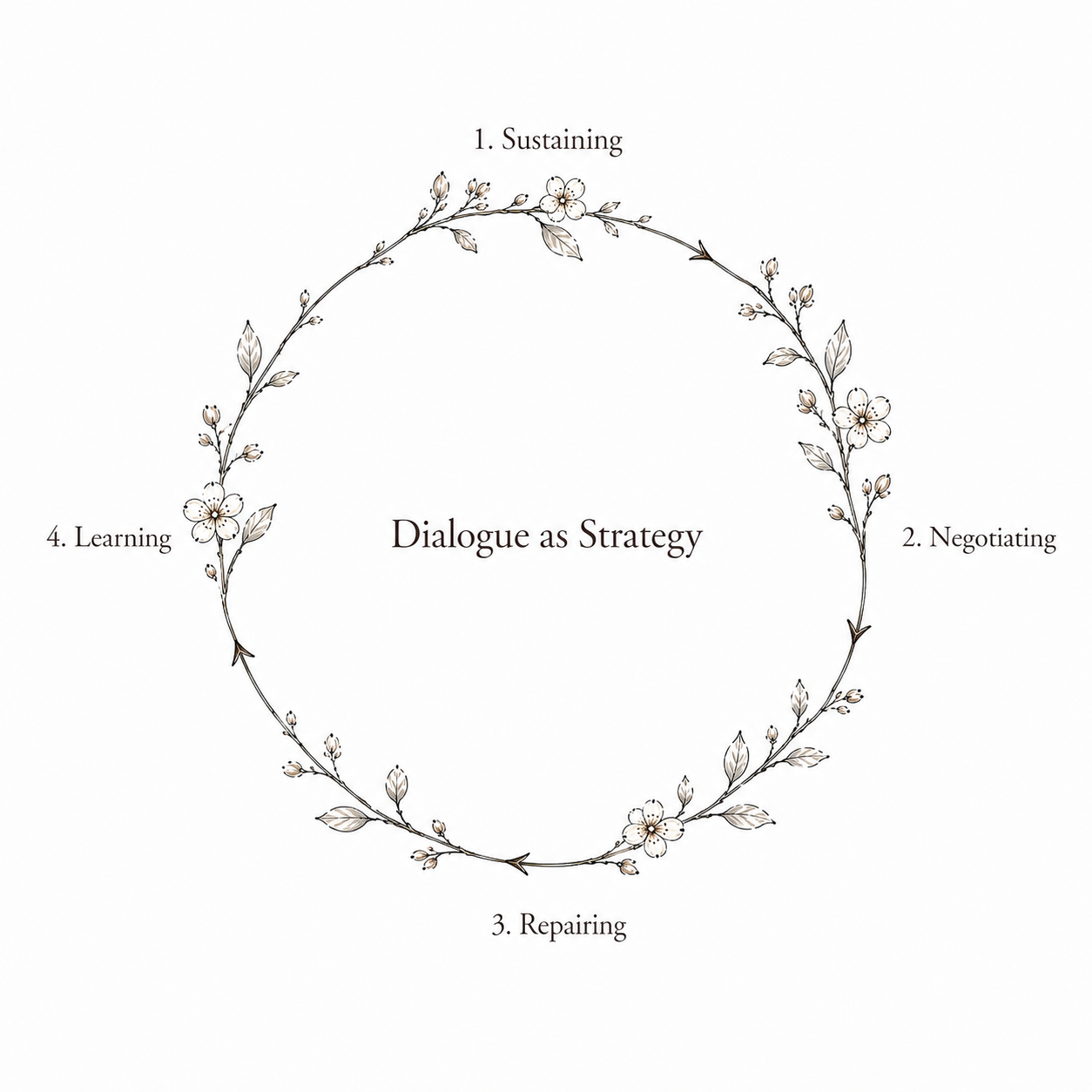
Alignment sustains the practice of navigating cultural difference over time. Through dialogue, collaboration can create space to sustain trust, negotiate difference, repair friction and carry learning forward.

Circular wreath: Sustaining, Negotiating, Repairing and Learning around Dialogue as Strategy
The Alignment cycle: sustaining trust through dialogue

Sustaining

Maintaining what has been built

How do we maintain trust as people, relationships and contexts evolve?

Trust is not built once and left alone. As people, relationships and contexts evolve, maintaining trust requires ongoing attention and renewal.

Dialogue creates space to revisit assumptions, ask new questions and continue learning from one another. As lived experiences shape how people understand themselves and their relationships, what once felt understood may need to be revisited.

Alignment therefore functions as a continuous loop rather than a final destination—creating opportunities to renew understanding, adapt to change and sustain the trust that supports collaboration.

Negotiating

Adapting while preserving self

How do we adapt across cultural difference without losing ourselves?

In cross-cultural collaboration, identity is not fixed. As people encounter different perspectives, expectations and ways of working, they may find themselves negotiating how they show up in the relationship.

Adaptation can create tension between the authentic self and the negotiated self. Being aware of this tension allows us to ask what adaptation feels right without assuming that changing our behaviour means abandoning who we are.

Dialogue creates space to explore these tensions openly—to acknowledge the other while remaining attentive to how we are changing ourselves. The goal is not to choose between authenticity and adaptation, but to find ways of engaging that respect both, preserving mutual dignity and allowing trust to continue developing.

Repairing

Responding when friction occurs

How do we respond when friction or misunderstanding occurs?

Intercultural collaboration is complex, and friction can emerge when different cultural perspectives, expectations and ways of working come together. Even with preparation and well-intentioned dialogue, misunderstanding and conflict can still occur.

When misalignment happens, dialogue creates space not only for expressing what has happened, but also for listening deeply to the perspective of the other. This can help collaborators understand where the misalignment comes from and explore whether the relationship can be repaired.

Repair does not always mean reaching agreement. Dialogue may create possibilities for clarification, compromise or a different way forward, while also making visible where boundaries or values cannot be reconciled. Trust can be fractured even when people have made a genuine effort to navigate cultural difference.

For this reason, repairing also requires reflection on what is needed to rebuild trust—and whether rebuilding it is possible or desired. If a collaboration continues, dialogue can strengthen the relationship by creating opportunities to learn, adjust and renew trust. If it does not, the experience can still provide insight that is carried forward.

Learning

Carrying insight forward, even when collaboration ends

What can we learn from an intercultural experience and carry into what comes next?

Intercultural collaboration is an ongoing process of learning. Each experience can build greater self-awareness, adaptability and discernment for future encounters.

When challenges arise, reflection can help us recognize what has been learned. Dialogue can help surface different perspectives, question our interpretations and discern whether the relationship can be restored. When collaboration continues, the framework becomes a continuous loop—returning to cultural difference, adapting through experience and allowing trust to deepen over time.

When collaboration ends, the experience does not have to end with it. What we learn from navigating difference—including what worked, what did not and what we might approach differently—can build resilience and inform future collaborations.